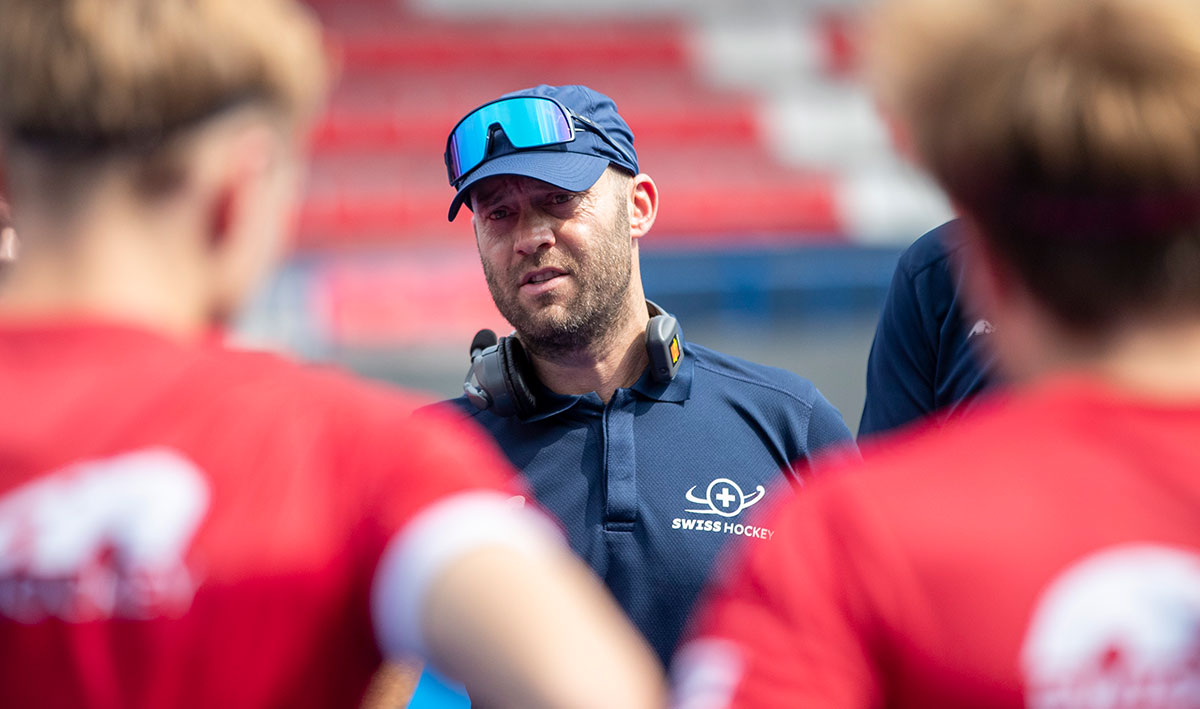
Swiss Hockey: The U21 boys in India, the women at the WCQ in Chile – can you top that Jair?
Jair: Of course we always hope that the next chapters will be even better than the last. At the same time, we mustn’t forget how special these two events were. You don’t get to experience an U21 World Cup in India every year, and the women put in a strong performance on the international stage in Chile. At the same time, we should not forget the indoor season. Both our women and our men have qualified for the A European Championships for the third time in a row. These are also absolute top performances for a small field hockey country like Switzerland.
Perhaps it is even a nice sign that such successes are now almost taken for granted. A few years ago, such results would have been real sensations. Today we talk about what comes next. This shows that Swiss Hockey has developed sustainably in recent years and that our national teams are becoming increasingly competitive internationally.
For me, it’s not about comparing individual highlights. It is much more important that we as an association move forward step by step. If our national teams regularly take part in major international tournaments, are competitive and young players make the leap to this level, then we are doing a lot of things right. The best moments are hopefully still ahead of us.
Swiss Hockey: The EuroHockey Qualifier tournaments for the men and women are coming up in mid-July. Who are our opponents? What is the goal? And how do you rate our chances here?
Jair: The women will play Ukraine in Prague and Poland/Croatia in the second game. The men will face Croatia in Rome and Scotland/Turkey in the second game. The opponent in the third game depends on the results of the first two games.
Our goal is clear: we want to make it into the A Division. That’s particularly attractive this year because the EuroHockey Championship will be expanded from eight to twelve nations from 2027. The two finalists in each qualifying tournament will qualify directly for the A European Championship in London in 2027. Whoever wins the first two games is already in the final and has advanced. That’s why our focus is clearly on winning the first two games!
At the same time, we have to remain realistic. Nations like Scotland, Poland, the Czech Republic and Austria invest significantly more in their national programs and have more touchpoints than we currently do. We were only able to organize a very small preparation programme this time, which is obviously not the best way to prepare.
But every game starts at 0-0 and a lot can happen in 60 minutes. We have talented teams, good staff teams, a clear game plan and a group of players who are ready to give their all for Switzerland. If we play to our level and function as a team, we can pose major problems for any nation. That’s exactly how we see ourselves when we travel here.
Swiss Hockey: Two weeks later, it’s the turn of the U21 boys and girls at the EuroHockey Championships. The same questions apply here: Who are we up against? And how do you rate our chances?
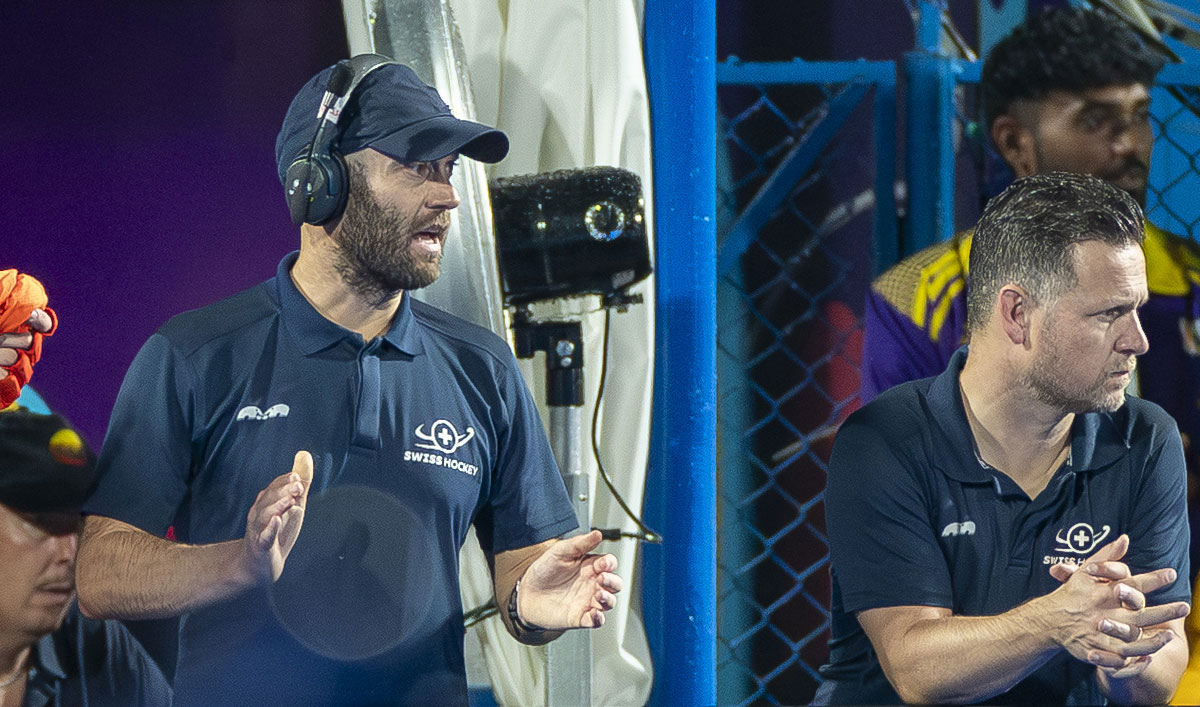 Jair: The starting position for the U21 Boys is completely different to that of the U21 Girls. Our boys are competing against the absolute best in Europe in Valencia. In a group with Germany, Belgium and France, there is a lot of quality waiting for us. Germany won the Junior World Championship in India just a few months ago, while Belgium and France have been among the European elite for years.
However, we earned this place ourselves by winning the B European Championship in Lausanne two years ago and making it through to the next round. Now we have to show that we belong at this level. It certainly won’t be easy, but games like this are incredibly valuable for the development of our players. Our aim is to grow in the tournament, perform competitively and ultimately see if we can play for another ticket to the next Junior World Championship.
The situation is slightly different for the U21 girls. After an absence of several years, we have once again entered a team for the European Championships. The team will face Austria, Poland, the Czech Republic and Turkey. We first have to see exactly where we stand in international comparison.
The new staff, led by Bas de van der Schueren and Jasper Härtsch, is already working hard to form a strong team. The aim is to compete for the medals. However, it is even more important that our players gain valuable international experience. If we want to continue the positive development of our women’s national team in the long term, we need young players who can gain experience at this level and make the step up to the active national team in the medium term. This is exactly why tournaments like this are so important.
Swiss Hockey: We still have some time before the tournaments. How are the preparations going? What does the preparation cycle look like? Where do you place the emphasis?
Jair: Preparations for the men’s and women’s teams are of course somewhat limited this year due to our options – unless you count the women’s World Championship qualifiers in Santiago as a preparation tournament. 😉
Between Easter and Whitsun, we held Monday evening training sessions at the facilities in Wettingen, Lucerne and Olten. At the same time, smaller groups of players from various national teams met in Lausanne for additional sessions.
The decisive preparation weekends for the men’s and women’s teams, as well as the U21 men’s and U21 women’s teams, will follow at the end of June, when the final squads for the European Championships will also be announced.
- Women: June 19-21: Training course in Lucerne
- U21 women: 27-28 June: training course in Wettingen
- Men: 26-28 June: Test series against Italy in Lucerne
- U21 Men: 26.-8.6: Training course in Lucerne
The men’s and women’s teams will then travel to Prague for the newly launched Alps Cup. From July 2 to 5, we will face Poland, Croatia, the Czech Republic and Austria. Unfortunately, France and Italy were unable to take part this year, but we hope that the field of participants will continue to grow in the coming years.
After the Alps Cup, the women will stay in Prague for their EuroHockey Qualifier, while the men will travel on to Rome.
The U21 teams will then take over from July 16-19. The U21 girls will complete a series of tests in France, while the U21 boys will use a final preparation weekend in Lucerne to work on the final details for the European Championships.
On July 24, both teams will travel to their tournament venues – the U21 women to Vienna, the U21 men to Valencia – where the EuroHockey Championships will take place from July 26 to August 1.
The focus in all teams is not only on tactical content, but also on team development and a clear playing identity. Precisely because our training time together is limited, we have to use every session as efficiently as possible and ensure that everyone knows how we want to perform and what we want to stand for as a Swiss national team.
Swiss Hockey: Thun have become Swiss champions. FC Elversberg (a village club in Germany with a population of around 13,000) sensationally achieved promotion to the 1st division. What do we want to achieve with our national team?
Jair: Stories like this show that size alone does not determine success. What matters is a clear vision, hard work, continuity and people who believe in something together.
That’s exactly what we want to achieve with Swiss Hockey. We know that we are a small country and a small field hockey community compared to many other nations. But we want to show that you can still achieve great things with passion, good training and a strong culture.
Our goal is not just to achieve good individual results. We want to build a sustainable national team program that the entire field hockey family can be proud of. An environment in which young players dream of playing for Switzerland and in which the national teams serve as role models for the entire sport.
In other words, we want to leave Swiss field hockey stronger than we found it, year after year. Legacy through Effort.